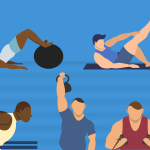
Your code is clean. Your algorithms are efficient. Your posture, however, is a catastrophic failure. Your physical form is throwing more exceptions than your code on a Monday morning after a three-day hackathon.
Welcome, fellow developer, to the most critical system you’ll ever maintain: your body. It’s time to push a new commit to your fitness repository. Let’s refactor you from a human question mark into a functioning human being.
1. The Pre-Commit: Acknowledging the Problem
First, let’s diagnose the legacy system. The average programmer’s body is a marvel of modern engineering, optimized for:
· Sitting: The primary activity. We sit to code, to think, to eat, and sometimes, to contemplate why we chose a life of sitting.
· The Snack-Based Fuel System: Running on a delicate balance of caffeine, sugar, and sheer willpower.
· Posture of Despair: Shoulders rolled forward, head jutting out like a turtle seeking its keyboard, spine in a permanent C-shape.
This isn’t just an aesthetic issue; it’s a technical debt that accrues painful interest in the form of back pain, crippling wrist issues (Hello, Carpal Tunnel!), and the energy levels of a zombie on a low-battery mode.
2. The Architecture: Building a Robust Fitness Framework
You don’t build an app without a plan (well, most of the time). Don’t just flail at the gym like a noob trying to use Vim for the first time. Design your fitness architecture.
A. Resistance Training: Pushing Your Physical Pull Requests
This is your core functionality. Strength training fixes the bugs in your musculoskeletal system.
· The Anti-Hunchback Protocol: For every “push” exercise (chest press, shoulder press), you must do a “pull” exercise (rows, pull-ups, face-pulls). This balances out the hunched-over-a-laptop posture. Think of it as resolving merge conflicts in your shoulders.
· The Foundation: Squats and Deadlifts. These are your system’s backend. They work the biggest muscle groups, boosting your metabolism and making you fundamentally stronger. It’s like optimizing a slow database query – it makes everything else run faster.
· Reps and Sets: Start with 3 sets of 8-12 repetitions. This is the “Hello, World!” of weightlifting.
B. Cardio: Clearing Your Cache
Cardio is not the enemy. It’s like garbage collection for your cardiovascular system. It clears out the mental clutter and improves blood flow to your brain, which might just help you solve that bug you’ve been staring at for four hours.
· The Pomodoro of Pain: Can’t spare 30 minutes? Try the “Pomodoro Cardio” method. After 25 minutes of deep work, do 5 minutes of intense cardio—jumping jacks, burpees, running up and down the stairs. It’s an agile approach to fitness.
· Walk and Think: When you’re stuck on a complex problem, go for a 15-minute walk. Your brain’s background processes will often compile a solution while you’re away. Steve Jobs was famous for his walking meetings. You can be famous for your walking debug sessions.
3. The Micro-Optimizations: Code Snippets for Daily Life
You don’t need a full system overhaul to see improvements. Sometimes, it’s the small, consistent habits.
· The Standing Desk (The Mythical Legend): If you have one, use it. If not, create a “poor man’s standing desk” by piling books on a table. The goal is to break up the 8-hour sitting marathon.
· The Ergonomics Patch: Fix your workspace. Your screen should be at eye level. Your elbows and knees should be at 90-degree angles. This is the equivalent of writing clean, readable code for your spine.
· The Hydration Loop: Keep a large water bottle on your desk. Every time you finish it, you must get up and refill it. This forces regular movement and hydration. It’s a simple while(alive) { hydrate(); } loop.
· The 20-20-20 Rule: Every 20 minutes, look at something 20 feet away for 20 seconds. This is a minor patch for your eye strain, but a major victory for your cervical spine, giving you a brief break from the “text-neck” position.
4. The Mental Gymnastics: Handling the `NullPointerException` of Motivation
Your motivation will return null. It’s inevitable.
· Don’t Break the Chain: Use a calendar. Put a big, satisfying red ‘X’ on every day you complete your workout. The visual of an unbroken chain is a powerful motivator to not skip a day.
· Pair Programming (The Fitness Edition): Get a gym buddy. It’s much harder to bail on a workout when someone is waiting for you. You become each other’s unit tests for accountability.
· Gamify It: Use a fitness tracker. Turn your life into an RPG where you level up by taking steps and closing rings. Because if there’s one thing we understand, it’s the dopamine hit of achieving a meaningless, digitally-rendered goal.
Conclusion: The Final Build
Fitness for a programmer isn’t about becoming a gym-obsessed meathead. It’s about system maintenance. It’s about ensuring the hardware (your body) can effectively run the software (your brilliant mind) for decades to come, without crashing.
So, the next time you’re about to dive into a deep coding session, remember: the most important compiler you have to please is your own body. Stop letting it throw errors. Get up, stretch, lift something heavy, and then return to your keyboard—not as a slouching code-monkey, but as a more alert, more energetic, and frankly, much less achy engineer.
Now, git commit -m “Initial fitness commit” and go fix yourself. Your merge request is approved.